
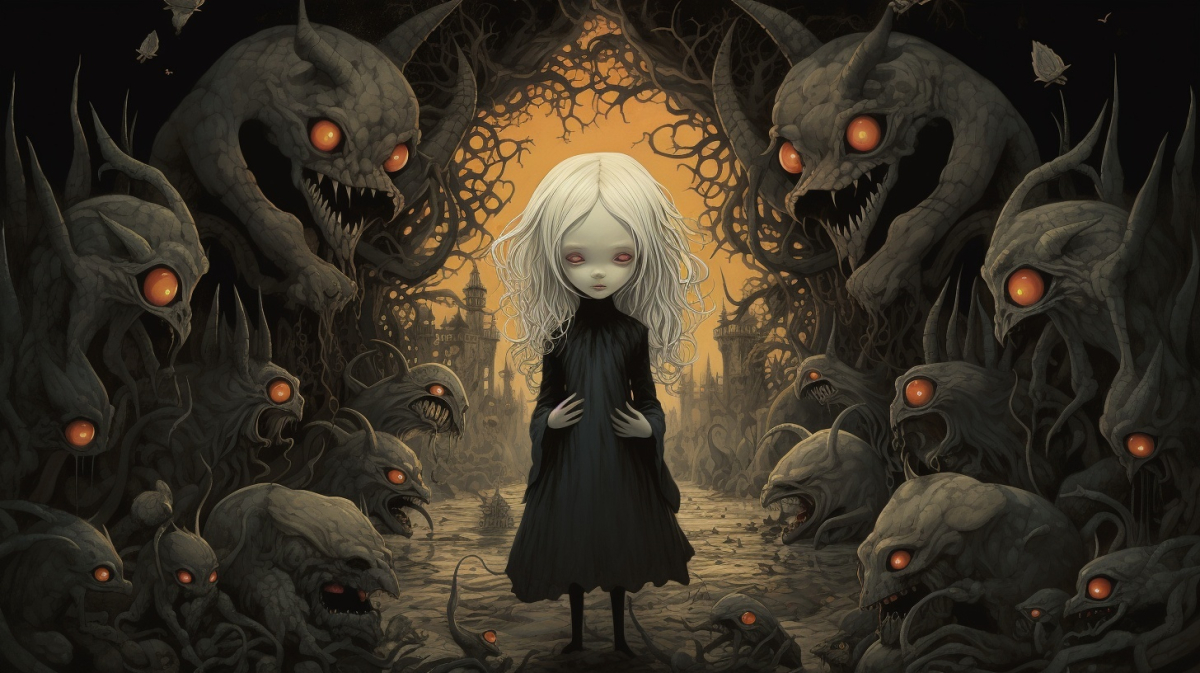
Fear should repel us. Biologically, terror is designed to keep us away from danger. Yet horror stories—the ones that leave us sweaty-palmed and staring at the dark corner of the bedroom—have been with us since the first campfires. And not only have they persisted, they’ve thrived: from Gothic novels to streaming horror franchises, from whispered folktales to multi-million-dollar box office hits.
Why do we keep turning toward fear as entertainment? The answer, it turns out, lies at the intersection of psychology, anthropology, and history. Horror doesn’t just scare us—it serves deep psychological needs and reflects the cultural anxieties of every age.
The Science of Being Scared
Your Brain on Horror
When you watch a slasher film or read a ghost story, your brain behaves as if the threat were real. The amygdala, the brain’s fear hub, fires off, adrenaline surges, your heart races, and muscles tense. It’s fight-or-flight, minus the sabertooth tiger. In safe contexts, this cocktail of chemicals is intoxicating, not traumatic.
Psychologists call this benign masochism—the thrill of enjoying something unpleasant when we know it won’t actually harm us. The American Psychological Association explains that horror movies offer “a controlled way of experiencing fear,” letting us practice coping with negative emotions in a safe environment (APA).
The Sweet Spot of Scary
Not all fear is fun. Too much (real danger, genuine trauma) overwhelms us. Too little (a boring ghost story) leaves us flat. Horror works when it balances the tension perfectly—scary enough to trigger adrenaline, safe enough that we can laugh when it’s over. That delicate equilibrium explains why people ride roller coasters, eat spicy food, and line up for haunted houses.
Ancient Monsters, Ancient Lessons
Horror stories aren’t modern—they’re prehistoric. Every culture has monsters that stand in for what it fears most.
- Mesopotamia: demons like Pazuzu personified disease and drought.
- Greek mythology: the Gorgons punished hubris and lust.
- Japanese kaidan ghost tales embodied the vengeance of the restless dead.
- Medieval Europe: tales of witches, werewolves, and the Devil served as sermons against sin.
As BBC Culture points out, scary stories historically doubled as survival tools—teaching children not to wander into the woods, to respect the dead, and to avoid strangers (BBC).
Horror has always been more than entertainment. It is a cultural Rorschach test. What we fear in fiction reveals what defines—and threatens—us in reality.
The Gothic Invention of “Literary” Horror
The 18th and 19th centuries formalized fear into literature. Mary Shelley’s Frankenstein (1818) captured anxieties about science and human ambition. Bram Stoker’s Dracula (1897) distilled fears of contagion, sexuality, and foreign invasion. Edgar Allan Poe turned madness into poetry.
As Smithsonian Magazine notes, Gothic literature’s popularity in the 19th century wasn’t just a fad—it was a reflection of industrial upheaval, shifting gender roles, and a society learning to live with technology it didn’t yet understand (Smithsonian).
Horror novels weren’t escapist—they were diagnoses of cultural illness.
Freud, Jung, and the Monsters Within
Freud and the Uncanny
Sigmund Freud’s 1919 essay The Uncanny defined that unsettling feeling when something familiar turns strange—like dolls that blink or shadows that move. Horror thrives on this uncanniness: the familiar made unfamiliar, the home turned haunted.

Jung and the Shadow
Carl Jung argued that monsters externalize our shadow self—the repressed parts of our psyche. The werewolf is rage we refuse to acknowledge. The vampire is forbidden sexuality. The zombie is our fear of losing individuality. Horror provides a stage for our shadows to walk, so we can confront them without being destroyed.
Why Horror Booms in Times of Crisis
Look at history: horror always spikes during societal upheaval.
- 1930s Universal Monsters: Frankenstein and Dracula mirrored Depression-era fear of outsiders and science run amok.
- 1950s-60s Sci-Fi Horror: alien invasions and radioactive mutations tracked with Cold War paranoia and nuclear dread.
- 1970s Slashers: cynical, bloody violence arrived after Vietnam and Watergate shattered faith in institutions.
- 2000s Zombie Mania: from 9/11 to financial collapse, zombies embodied mass anxiety about terrorism, contagion, and consumer culture.
- 2010s–2020s Elevated Horror: films like Get Out and Hereditary turned horror into sharp cultural critique—racial trauma, familial dysfunction, climate collapse.
As The Guardian notes, horror is less escapism than catharsis. It allows us to scream about one thing while quietly processing another (Guardian).
Horror as Social Commentary
Horror doesn’t just mirror fear—it critiques it. Jordan Peele’s Get Out exposed liberal racism. Ari Aster’s Midsommar turned relationship breakdown into folk horror. Even classics like Night of the Living Dead (1968) doubled as commentary on race and violence in America.
Horror is uniquely suited for this work. By exaggerating anxieties into monsters, it reveals truths polite society won’t name. As a genre, it has always punched above its weight in honesty.
The Pleasure of Control
Here’s the other paradox: horror is terrifying, but it’s also empowering. When we watch a scary movie, we get to control fear. We can pause the film, put down the book, walk out of the haunted house. That sense of agency transforms terror into thrill.
National Geographic explains that humans evolved to rehearse danger—telling scary stories was a form of collective practice for survival. Today, horror serves the same function: we prepare ourselves for worst-case scenarios in a safe rehearsal space (National Geographic).
The Future of Horror: Fear Goes Digital
What will horror look like in the AI era? Likely more uncanny than ever.
- AI-written creepypasta already floods forums with eerily coherent ghost tales.
- VR horror games immerse players in fear with no safe screen to hide behind.
- Digital paranoia—deepfakes, Dead Internet Theory, surveillance horror—are already sliding into scripts.
Tomorrow’s monsters may not be vampires or zombies, but algorithms, simulated realities, and data doubles. The uncanny has gone online.
Why We’ll Always Tell Scary Stories
From ghostly folktales to modern elevated horror, scary stories are not just about being scared. They are rituals, survival tools, psychological rehearsals, and cultural critiques. They let us face death and dread in miniature, with laughter or relief waiting at the end.
We don’t love horror because we’re broken. We love horror because it reminds us we’re alive.
Or as H.P. Lovecraft, prophet of cosmic dread, once wrote: “The oldest and strongest emotion of mankind is fear, and the oldest and strongest kind of fear is fear of the unknown.”
Need a great horror story to read?
- psychological thrillers that will have you checking your locks at night
- horror books for when you’re too old for goosebumps
I’ve spent 15 years helping authors write, publish, and sell books. When I’m not writing, I’m probably in a castle somewhere with cats.

Add Comment