
For the past year, I’ve been working on a new tool. It started, because I was thinking about translating my books but the main AI book translating tool costs too much, and I have a lot of books. The key feature, is being able to submit all your chapters at once.
But then KDP added instant AI translations.
So I turned it into a proofreading tool, and it’s pretty good at that too. And some AI models are SO cheap, I can give it away for free. This is pretty exciting, I love to give things away. As an editor, I hate manually fixing thousands of stupid punctuation issues on a manuscript; I also hate using Grammarly or ProwritingAid to manually approve every single little thing.
I think proofreading is something the robots can do pretty well. For humans, it sucks, and it’s time consuming, and you actually have to know grammar – my first online business was an editing company, I have a PhD in literature, I’m pretty competent with stuff like that, I know a lot of words, I can find and fix most mistakes. But it’s boring, pedantic work.
Recently on Reddit, an author was asking about a proofreading quote of $3000. Most of the comments said that was normal. Which is annoying. I get it, if you want quality, a $300 option may not have worked, at least a few years ago. But the truth is, you can proofread, copyedit, even line-edit a book to improve the style… and still not fix any of the major structural issues of that book!
I’ve long felt uncomfortable about polishing books without fixing the fact that the story is broken, unsatisfying, unremarkable, which is why I prefer developmental editing. But I loathe the idea of authors paying tons of money especially JUST for proofreading – without getting any real, solid feedback that could actually help them make it better.
An alternative, not a replacement
I get that AI is scary and controversial. I’ve been pretty quiet about it this year. I don’t consider myself pro-AI because it’ll probably end humanity but I didn’t have high hopes for us anyway. But the super annoying this is that AI is already inside of all the programs I’m using; it’s in Photoshop, Windows, Google, Word – I can turn it off or tune it out.
It sucks that we are definitely losing brain power by having AI do basic things for us. On the other hand, we don’t have much brain power to begin with; I’m usually too exhausted just keeping up to invest on my creative projects. There are many things I just don’t do, or leave unfinished or incomplete, which is also a slow drain on resources; the pile of possibilities.
But previously, in regards to self-publishing, there was only one real option: hire expensive help. Solutions exist for rich people. But where are the solutions for poor people (and honestly, aren’t we all poor now with the way things cost?)
I tentatively put my tool online, and quietly mentioned it in a couple places: “I built a free, full-book proofreading tool.”
The first reply was:
“Keep your idiot AI crap to yourself.”
AI writing vs AI editing tools
I’ve written a lot of books. I’m not the best writer ever but I have figured out the process, it’s never easy, it’s always a struggle, it takes me many months of work to write books, and I procrastinate a lot – which means I have 10 open unfinished series and readers probably hate me.
At my own pace, I will never complete all my work in this lifetime.
So I’m open to the idea of AI helping me with some of the burden. I haven’t yet found a tool that can write chapters to my standards. I’ve had friends say, why not write a rough draft and pay an editor? My response was, why would I pay for something I can do better myself?
I’m all for hiring out things I cannot do, but editing is something I’m pretty good at.
I think the tools probably are capable at this point, if I spent enough time learning how to use them – and I’m not talking about just writing a book with AI. If you ask AI to write a book, you’ll get the same book as everyone else with the same lame names. It’ll still be, honestly, better than many authors very first attempts. AI can do mediocre well, and maybe it’ll never achieve greatness, but how many humans ever do?
No, I just want help writing my sequels; which means, learning my writing, my worldbuilding, my characters, and helping me put out a rough draft I can edit that’s pretty close to what I would have written. I don’t use it for ideas, I’m training it on my own style, I don’t actually need help with the developmental editing part – figuring out what’s wrong with the story and how to fix it – that’s the part I love.
I also don’t feel the need to prove myself as a writer. The conversation around AI usually defaults to the idea that using AI means you are not a real creator. You aren’t an author or a writer or an artist. You don’t have the skills, you didn’t do it yourself, you’re a fraud.
That conversation doesn’t impress me, because being an author is not my identity. I’m not trying to get people to see my great literary talent. I’ve written books people like and I want to finish those stories so people can enjoy them. I have a quality metric, absolutely – I will not put out a book I think is not up to my standards. I’m aware though, that my quality standards don’t necessary improve the enjoyment of the book. Someone called me a perfectionist and I pointed out, most of my books have typos, and have had them there for years.
The other thing people often say is, why would you use AI to do the writing, that defeats the whole point! Because for them, the mystery of the creative process, and struggles and joys, those are the benefits. And they can be – if you ever finish. For many, many people who want to write a book, they just don’t have the time or the skills to do it justice, so the book just never gets written. It’s a personal failure, a solitary defeat we carry with us.
There are many pieces to book writing. I know of some famous bestsellers, that had an idea and a rough batch of notes, for a skilled developmental editor to turn into a commercial success – building the structure and even the title. I have pantser friends who finish quickly and hand it off to an editor, I have plotter friends who plan ahead and fill in the blanks slowly.
But mostly, mostly, I see people struggling for years and years and years, still failing, still frustrated, and there are no easy solutions. Everything costs a lot. Scams are rampant.
AI cowriters and ghostwriters
Where is the value, who is the creative, how much does creativity add to the earning potential of a finished project? These are philosophical discussions. For me, it’s either a good book readers enjoy, or it is not. The assumption that all AI writing is terrible or that AI can’t write a good book because it doesn’t have a soul, these are ungrounded opinions, and the facts show the oppositive.
Consumers, as much as we hate to admit it, often prefer AI writing samples to their human equivalent. AI slop is going viral on social media, not because people can’t tell, but because they don’t care. Show me a funny cat video and I’ll like it, even if it’s not a real cat with a real human behind the camera.
But having AI write for you, since the tools are available and apparently yet to be illegal, is a personal choice and something I have no (legal) right to judge you for; I also can’t ignore, that these tools are providing immediate and powerful ameliorative effects (see, I know words like that without even having to check my spelling!).
If someone is suffering with a painful problem and there is no help or relief apart from paying more than they can afford, I can’t begrudge them any attempt at using cheaper tools. And now… finally, for the tools themselves…
An AI editing tool for books
I was very excited to share this, and I’m frustrated to feel the need to explain and justify its existence. I tend to get very excited about things and just want to share them. I made a video immediately the first time I got things to work well enough to impress me, because I’m not that easy to impress.
Like I mentioned, mostly it’s a tool that will proofread your entire book in one pass, for free. It doesn’t have to be free, but it costs about .03 cents to run – that goes up to .11 cents with all the other features I added below. I have a history of making free things that end up costing me money, and my wife made me promise we won’t sleep in the street, but I’m committed to keeping this free as long as possible, at least for the first book. If it’s useful enough and people keep using it, they can buy more credits.
Some of the advanced features, that need actual intelligence and creativity, need stronger and more expensive models. It’s actually trick to get AI to proofread your book, because it tends to overwrite or change too much and it doesn’t sound like you anymore; or because you’re copy+pasting chapters into a long chat thread, by the end it’s so much information the AI struggles to keep the voice and starts summarizing things – you need to always babysit and watch out for errors.
I wanted a tool I can just run a whole book through to clean up mistakes, so I can start the actual, deep editing stuff. But I couldn’t help seeing what else the tool could do, so it also gives you a pretty detailed beta reader report. Not only a summary or story bible, but also some very powerful developmental critiques and comments.
I actually trained it on some of my books and writing guides, and a 70K document based on comments I’ve made as developmental editor; common issues to watch out for and how to fix them.
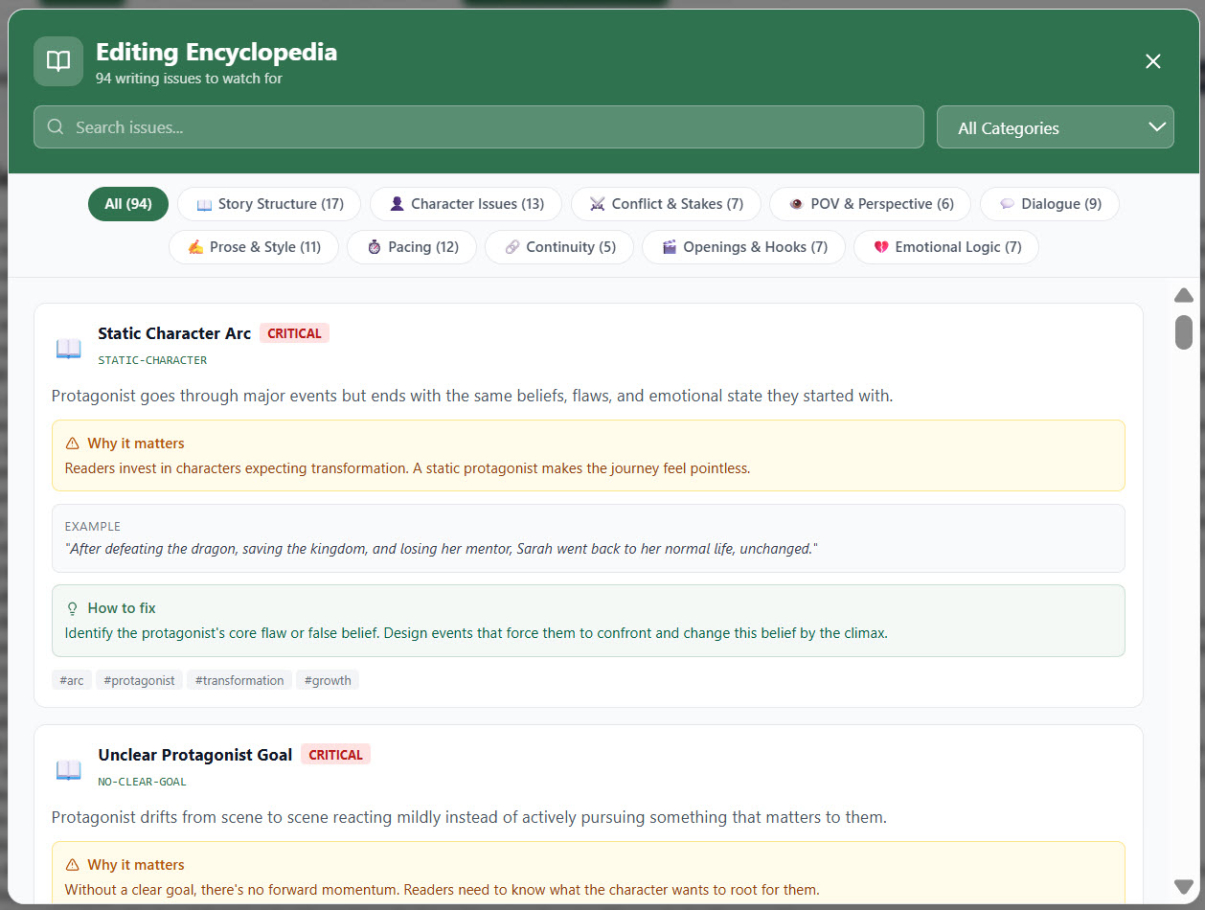
I don’t know if it’s ALL working just yet, but it should link to these specific issues in the editing encyclopedia so you can get more depth about the comments and issues the tool flags.
We don’t spend a lot of time on the little stuff like typos, punctuation, grammar – because the proofreading tool fixes all of that. Instead, you get specific story problems.
Detailed Beta Reader Report
This is the first, free version, and it’s already pretty good, but I know it can be better. It’s hard to find a beta reader or anybody who will give you real, honest feedback you can use – this tool should be really useful for most authors.

It’s SO long I had to cut a lot out and piece it together so you can even see it all.
AI chat with your book
The other thing I figured out, is a chatbot that can discuss a specific chapter with you, or a whole book. The first time I tried this, it wasn’t getting enough context – I asked what my characters looked like in Chapter one and it couldn’t answer, because I wasn’t sending the FULL chapter; and also because it’s a first person POV so it’s all “I” and nobody says her name… but I got that sorted. You can focus on each chapter in depth or the whole book at once.
This means EVERY question has to send a TON of information to the AI model, and it can get pricy fast – I’ve tried to make the best version, but the most important thing is it actually works. I asked for the weaknesses of one of my finished books, and it pretty much nailed them – there’s a quick and thoughtful mode, but both give pretty solid answers.

Revision, rewrites and ghostwriting with AI
I have some tricky manuscripts, I’ve already edited, they are nearly done, but there’s one or two big plot issues that just break the whole thing. I leave tons of comments, so I’ve figured out what’s wrong, what needs fixing, but going in and making these manual edits in the right places is a chore, and it might require some pretty heavy revisions.
In my mind, ideally, I can chat with AI, show them my notes and suggestions and solutions, and it could help me just revise my chapters to fix those issues. I’m very beta in that process right now, with the cowriter/ghostwriter tool, but I think I can get it to work.
This is the hard stuff, but it’s important: I usually leave hundreds of comments on the manuscripts I critique, and even if I give very good suggestions, doing all the work for an author without experience, can be overwhelming (it’s overwhelming even for me – just because you know how to do it doesn’t make it easy). And it’s not all creative – I’m not searching for creative solutions here, and it’s not about the prose quality. This is mechanics. This is changing a tire.

Copy-editing and line-editing with AI
Copy and line-editing is a little different; mostly, it’s like proofreading. Copy editing will put a little bit more effort into making it smooth and readable – removing problems that are distracting, like repetition, weird formatting or punctuation, strange grammar.
Line-editing goes even further, fixing the style, flow, cadence, making it better.
But how much better? It gets tricky here. What if the book is very bad, full of weak, amateur writing – does a good line editor rewrite it to make it better? Clean it up a little bit, or a lot? There are degrees. Most authors don’t want an editor to do to much, or change their voice.
Also, I’ll point out, prose isn’t really the most important thing – it must be clear, engaging, clean, but too much purple prose or a strong narrative style can be a weaknesses; it can even be a sign of amateur writing. Sometimes we need to tone it done. Remove stuff. Find a better way of presenting info without infodumps, presenting thoughts without internal whining or freezing the action. There are so many ways a good story can be told poorly, and usually an editor’s job is to make it just passably decent enough to readers can actually get through it.
But we’re not supposed to rewrite it or make it better.
There’s two big issues here.
On the one hand, like I mentioned, you can fix ALL the sentence-by-sentence writing and make it all great, and the whole story can still suck. Sometimes it doesn’t matter, but I like things to make sense; I like the drama and pacing and suspense and intrigue to all be effective; I like the ending to be satisfying. I’ve spent years figuring all this stuff out, and I have developed some rules, models, cheat-sheets, etc to try to communicate how authors can write better books.
Because it’s hard, it’s hard for all of us, but it’s also challenging and rewarding.
On the other hand, it sucks that an author may pay for proofreading, copy AND line editing and still end up with a clean book that’s no good. Sometimes, maybe, we want someone to just rewrite it to make it better… but this creeps into ghostwriter territory and ghostwriters are very expensive.
A temporary solution...
I worked really hard – this tool has already taken hundreds of hours – to make each level of editing edit appropriately. But I made two versions of line-editing, one that changes a little and one that changes a lot. Because sometimes copy-editing doesn’t fix what it needs to.
Here’s an example: I had chatGPT write some very bad raw fanfiction. Proofreading fixed ALL the errors and there were a LOT.
Copy-editing cleaned it up even more, made it better, but didn’t change the writing style. For some authors, this is good enough. This sample has a strong narrative voice, it might be just right for some projects. But… it also just isn’t that great, especially for the genre. The all CAPS words bothered me and the Whuppa-whump feels too comical. My line-editing pass kept the same story, the same content, but with heavier revision.
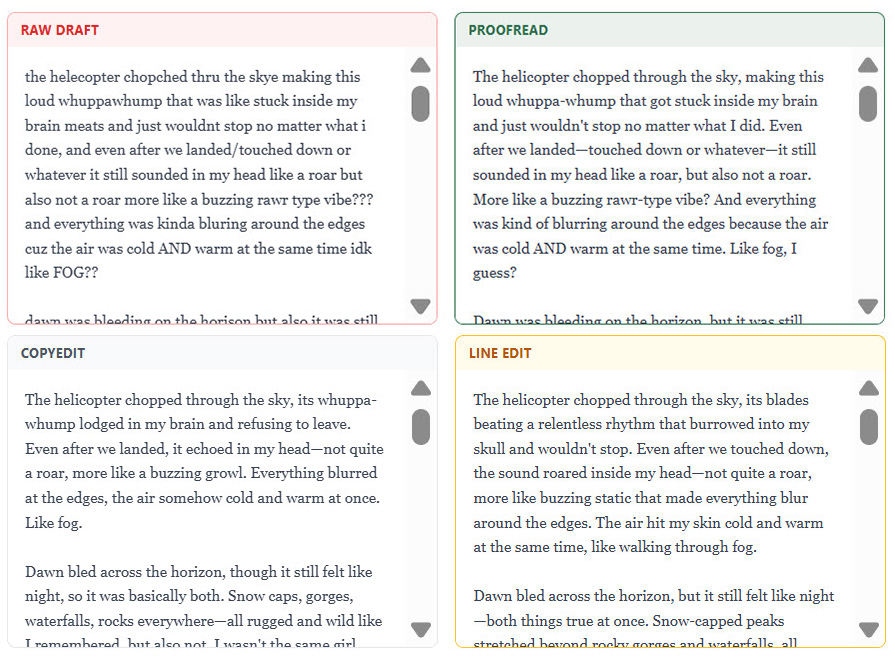
So, is it cheating – to write a rough raw fanfic like the first example and get it all fixed by AI like the final sample? I don’t think that question matters; or at least, it’s none of my business. A better question is, is it helpful? Is it useful? Are readers getting a better final product? Are authors required to spend less time in revisions? There’s not one simple answer.
The loneliness of it all…
Writing can be solitary, a pursuit of a goal that may take a lifetime. We’re bursting to talk with someone about our creative ideas; we love seeing our story develop. But at the end of the day, we also want it to be good enough that readers can enjoy it (most of us, anyway – it’s entirely possible to write for oneself and have no interest or intention of sharing it with readers).
The challenge is to let the joy and thrill of the challenge linger, without the inevitable depressive cycle that follows; especially without any kind of external feedback or confirmation that we aren’t just wasting our time.
Affordable Editing and Proofreading Tools
One last thing about the AI controversy specifically: most authors do their very best before handing a manuscript over to an editor. A tool like this should give them feedback earlier, so they can learn faster and avoid common mistakes. It should feel like a writing buddy, to bounce ideas off of.
It works better than prowritingaid or grammarly, because it’s automatic. And it can clean up your work without changing or rewriting it. The alternatives, are to hire a really good developmental editor, line-editor and proofreader to fix up your manuscript for you, or at least help, but like I mentioned before, these are very expensive options.
This is not supposed to be a tool that writes a book for you. It’s mean as a tool to get some of the value of a professional editor, even if you don’t have the budget to hire one. As an editor myself, I’m not concerned with being replaced, but I also don’t think defending my vocation is a selfless pursuit. I’ve been an artist all my life, but demanding authors continue to pay for things they cannot afford when there are solid alternatives, is misguided and insensitive.
My point there I think was… authors are already fine with using some tools for grammar and some people for editing; they are fine using tools for formatting or hiring a formatter. They are fine hiring a cover designer and making their own cover in Canva, but not (generally) AI covers. The lines are murky and blurring, between what counts as art and what does not; what is required to be done by the creator and what is permissible to pay an expert to do for you.
So I hope I’m not overstepping, by building tools that work better than a lot of alternative options, and giving them away for free: it’s a recurring theme of my life that people don’t truly value free and I struggle to confidently charge because it’s not really about the money but getting people to like me.
I’m not so good at business, maybe… I’m just good enough, sometimes, to be able to afford the luxury of working on my novels for a while. But I am pretty good at figuring things out and sharing what works.
What’s next for AI writing tools?
I’ve tried building tools over the years but always got stuck, since I’m not a developer – this year AI has helped me be able to code and fix a bunch of my stalled out projects. I have paid developers a lot of money, and never ended up with a finished project. I tried it that way. Now I’m building things on my own, because nobody else can commit to spending 10 hours a day on some random bug, and spending months of full-time work trying to make an online tool effective. I’m enjoying the challenge. I like making stuff. I’m building many things.
I made this because I wanted to see if I could. It’s not polished or professional; so I don’t have a big team or support. If people love it and share it, and if some people pay to use the higher features – like the Dev Critique I’m still working on – maybe I can focus on this one thing and make it even better. But AI tools change so quickly, it’s possible this is just a side project.
I also plan to build a big Scrivener alternative, a real writing software, based on my own 24 chapter templates; though for this month I really need to get back to my book cover templates, a decade-long pursuit that I may actually accomplish soon (I say that with little confidence, since I have yet to succeed, but that doesn’t mean I will fail forever).
Mostly, I want to be writing, I want to focus on my stories and characters. I tried online courses; I tried templates and tutorials; now I’m making software because the tools that exist aren’t good enough for the tasks I want them to accomplish for me.
Or, just because I think I can build things that help a lot of people, and I can do it for less than any competitor. Whether anybody uses it, likes it, shares it – that’s out of my hands.
Maybe I should keep my idiot AI crap to myself.
What’s in a name?
All these screenshots are from the tool I put up at Chapterra.com – branding is my absolute favorite thing to do, but I’m not convinced this is the best name for this tool. I might make versions of it for different websites. But maybe it’s good enough.
It’s an editing tool, not primarily a writing software, so my competition looks like this. I’d love to know if you feel like the name “Chapterra” works well enough for a tool of this kind; I’d love if you play with the features and let me know what works, or what doesn’t, or what could be better.
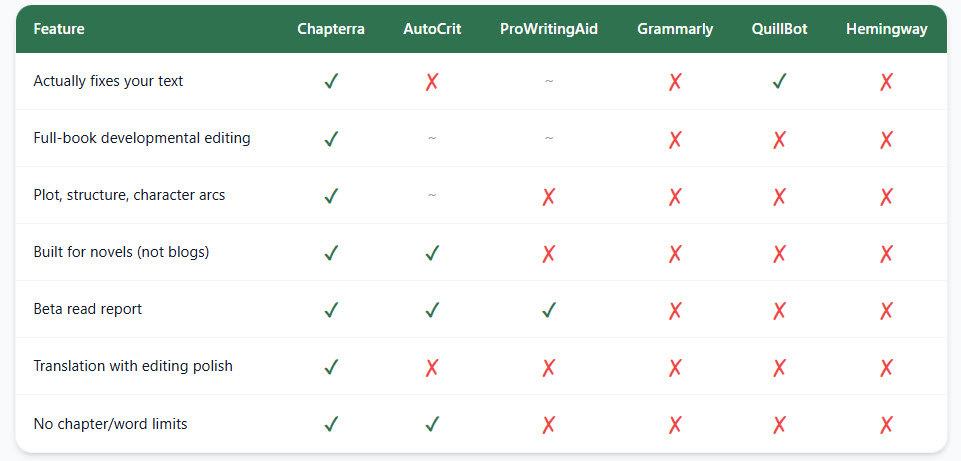
The goal is to keep this thing free forever – a full-book, 1-click proofreading solution for authors.
But that will probably only work if some people find the advanced features useful enough to pay extra to keep using them. If you’ve played with AI writing tools or software before, I’d like to know how my features compare. I’ve left an API option so you can use your own API and access smarter models for better results.
That’s it I guess, for right now. I spent all week without sleep fixing this up enough to post it, and now I’m fighting with a gruesome cold I have to acknowledge for awhile. I *hope* this is a good thing, and people like it. But I understand some people may not.
I’ve spent 15 years helping authors write, publish, and sell books. When I’m not writing, I’m probably in a castle somewhere with cats.

Add Comment